The Geometry of Figure Skating
When people watch figure skating, they often notice the jumps, spins, and choreography. What they may not notice is that the ice is quietly filled with geometry. Every movement traces lines and curves that are carefully controlled, even when they appear effortless.
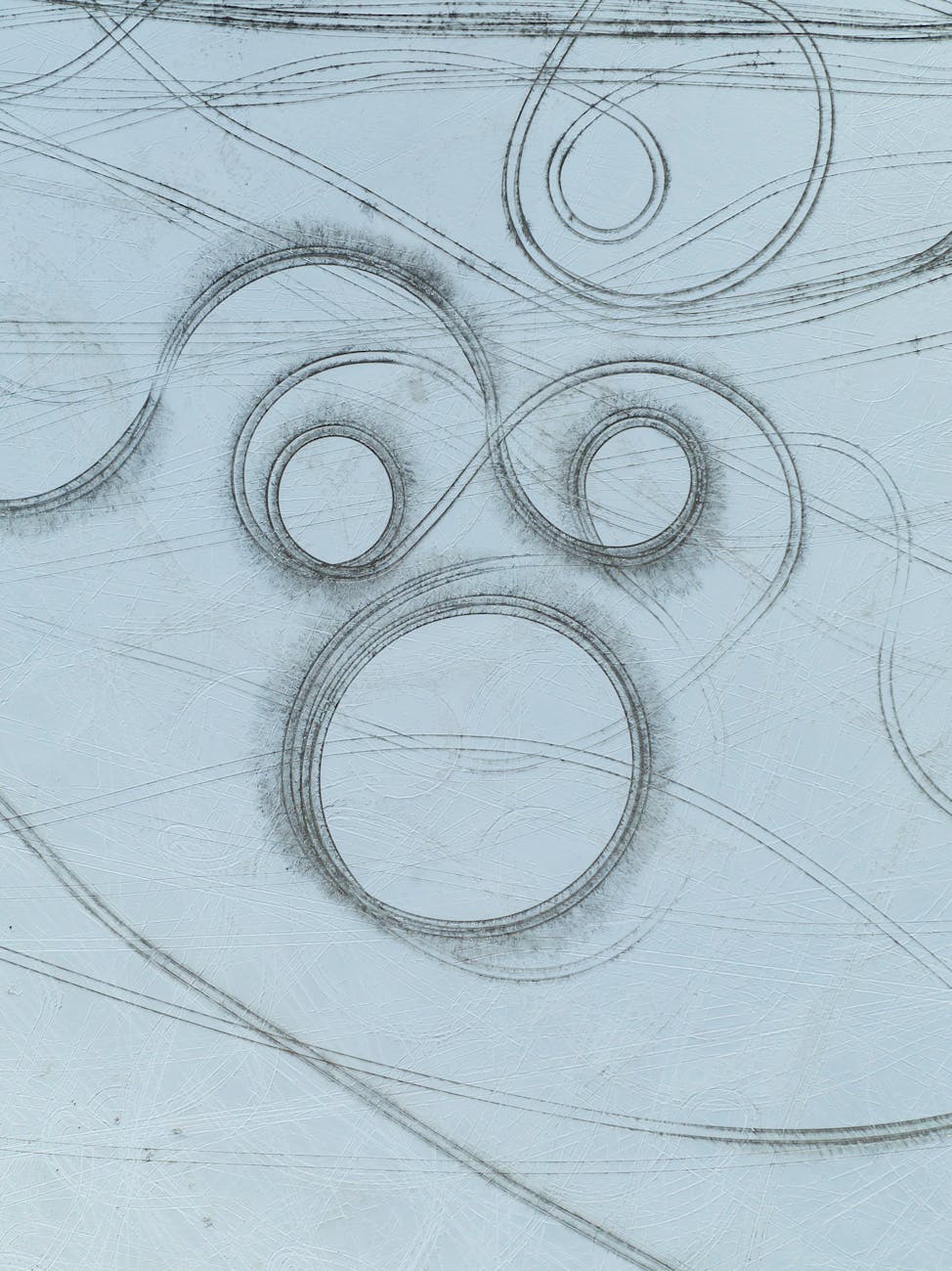
As a skater, I have started to notice how much of skating depends on shapes and patterns. The edges of the blades carve arcs into the ice. Circles, loops, and curves appear as we move across the rink. Sometimes when I look down after practicing, I can see the faint drawings left behind by skaters who practiced before me. The ice almost looks like a giant sheet of sketch paper covered with overlapping lines.
Many skating skills are based on circles. When practicing edges, we follow circular paths again and again, learning how to control balance and direction. Even the simplest exercises involve tracing clean curves on the ice. If the curve is uneven or wobbly, it usually means that something in the movement is slightly off. Over time, a skater learns to feel when the curve is smooth, almost like drawing a steady line with a pencil.
Spins also reflect geometric ideas. The body rotates around a central point, and the position of the arms and legs changes the speed of rotation. While skaters may not always think about the mathematics directly, the feeling of control often comes from understanding how the body moves around that center.
I have also started to notice how patterns travel across the ice. Footwork sequences create pathways that move forward, backward, and diagonally. Choreography often uses the full space of the rink, forming shapes that guide the skater from one movement to the next.
The more I skate, the more I realize that the ice is not just a surface to move on. It is a place where motion creates visible patterns. The lines that appear on the ice remind me that movement, balance, and geometry are closely connected.
Skating has helped me see geometry in a new way. Instead of only thinking about shapes on paper, I can feel them through motion. Circles, curves, and rotations become something physical rather than abstract.
Perhaps that is one of the reasons I enjoy both skating and drawing. In different ways, they both involve noticing patterns, shaping lines, and understanding how movement and form work together.
 Olivia Jordan
Leave a comment